Commercial variable recurring payments (cVRP) let a customer give a business permission to take payments of varying amounts from their bank account, within limits the customer sets once. The business can then collect each payment without the customer approving it again, and the customer's bank checks every payment against those limits. cVRP has been live in the UK since June 2026 for a first set of sectors, and it is only available in the UK.
That standing permission, with limits set by the customer and enforced by their bank, makes cVRP the basis for programmable payments in UK open banking: payments that run automatically within rules agreed in advance. Programmable payments are in turn what agentic payments depend on, because an AI agent can only pay on someone's behalf within a clear, bank-enforced permission. Our article on programmable payments and financial insights explains how these pieces fit together.
The scheme behind cVRP is run by the UK Payments Initiative (UKPI), and it is the first new UK payment scheme since Faster Payments launched in 2008. This guide explains what that means for your business, covering:
where cVRP fits among open banking payments
how a cVRP mandate works
how cVRP compares with Direct Debit and card-on-file
who can use cVRP today, and when e-commerce is likely to follow
why the mandate model matters for where payments are heading
If you're new to variable recurring payments, our introduction to VRPs covers the basics.
Exploring cVRP for your product? Talk to an open banking expert at Yapily.
Where cVRP fits in open banking payments
Open banking payments in the UK come in three forms, and cVRP is the newest. It is the only one that lets a business take repeat payments from a customer's account under a standing permission.
Single immediate payments | Sweeping VRP | Commercial VRP | |
|---|---|---|---|
Who gets paid | Any payee, one payment at a time | The customer's own accounts | A business, government body, or charity |
When the customer authenticates | Every payment | Once, when the mandate is set up | Once, when the mandate is set up |
How it is provided | Through banks' open banking APIs | Required for 12 banks including CMA9 since 2022 | Through a commercial scheme run by UKPI |
Status | Live | Live | Live since June 2026 for Wave 1 sectors |
Single immediate payments (Pay by Bank)
A single immediate payment, also known as a "Pay by Bank" payment, is a one-off payment from a customer's bank account, which the customer approves with strong customer authentication in their banking app each time. That suits one-off purchases well, but it means a returning customer goes through the same approval step on every payment.
Sweeping VRP
Sweeping VRP moves money between accounts that belong to the same person, for example from a current account into a savings or investment account. The largest UK banks have been required to offer it since 2022 as part of the Competition and Markets Authority's open banking remedies. It is already a meaningful share of activity: VRPs made up 15.67% of open banking payments in October 2025, according to Open Banking Limited, and customers made 7.73 million sweeping VRPs in June 2026, according to OBL's figures reported by Finextra. You can read more about how sweeping VRP works.
Commercial VRP
Commercial VRP uses the same idea of a standing, limited permission, but the payee is a business, a government body, or a charity. Because it pays third parties, it runs under a commercial scheme with its own rulebook and commercial model, operated by UKPI. Commercial VRP is only available in the UK.
How does cVRP work?
With cVRP, a customer sets up a mandate once and approves it with strong customer authentication. The business can then start payments within the mandate's limits without asking the customer to authenticate again, and the customer's bank checks each payment against those limits before any money moves.
Setting up a cVRP mandate
A mandate is the customer's standing permission, and its limits are agreed when it is set up. They cover:
the business being paid
the maximum amount for any single payment
the maximum total that can be collected within a set period, such as a month
The example below is illustrative only. It shows the kind of mandate a customer might agree with an energy supplier.
Mandate setting | Example |
|---|---|
Payee | Energy Max Ltd |
Maximum per payment | £100 |
Maximum per month | £200 |
Mandate length | 12 months from set-up |
Making cVRP payments under a mandate
Once the mandate is in place, the business starts each payment when it needs to collect, and the customer does not approve each one individually. Before a payment goes through, the customer's bank checks it against the mandate, so a payment that would break a limit is not made. cVRP payments are made over Faster Payments, the UK's real-time payment system.
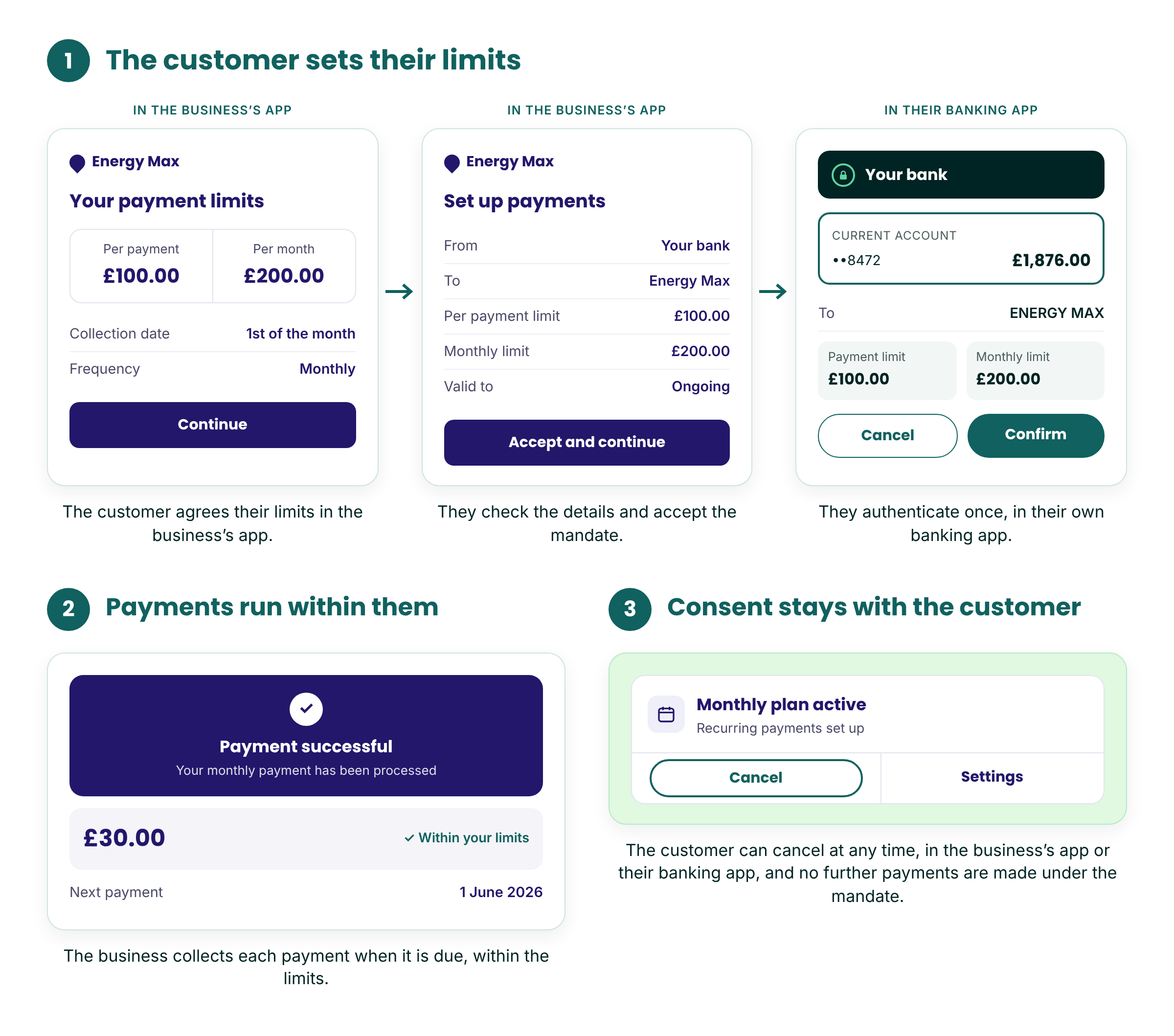 How a cVRP mandate works: the customer sets the limits once, payments run within them, and consent stays with the customer.
Changing or cancelling a mandate
The customer stays in control after set-up. They can withdraw their consent at any time, and cancellation takes effect immediately, so no further payments can be taken under that mandate.
cVRP vs Direct Debit and card-on-file
cVRP, Direct Debit, and card-on-file all let a business take repeat payments. They differ in who sets the limits, how payments move, what the business has to store, and what protection the customer has today.
cVRP | Direct Debit | Card-on-file | |
|---|---|---|---|
Set-up | Customer approves a mandate with strong customer authentication | Customer gives a Direct Debit instruction | Customer saves card details with the business |
Limits | Set by the customer and checked by their bank | Agreed with the business | Agreed with the business |
How payments move | Faster Payments | Bacs, taking up to three working days to process and settle | Card networks |
What the business stores | No card details | Bank account details | Card details |
Customer protection today | Existing legal protections for open banking payments; e-commerce purchase protection still being designed | The Direct Debit Guarantee | Chargeback rights |
Scale | Live since June 2026 in Wave 1 sectors | 5 billion payments in 2025 | Cards made up 64% of UK payments in 2025 |
Direct Debit is the benchmark for regular bills. It handled a record 5 billion payments in 2025, according to Pay.UK, and the Direct Debit Guarantee gives customers a well-understood route to a refund if something goes wrong. Its main constraint is speed, since a Direct Debit can take up to three working days to process and settle.
Card-on-file is the default for online subscriptions and repeat purchases, and cards made up 64% of all UK payments in 2025, according to UK Finance. It relies on the business storing card credentials, and customers can dispute payments through chargebacks.
When you compare commercial VRP with Direct Debit and cards, the differences are mostly structural. The customer sets the limits, and their bank enforces them; no card details are shared with the business, and payments move over Faster Payments. The open question is purchase protection for online shopping, which is part of the Wave 2 work covered below.
If your customers come back to pay again and again, our guide to Bank on File shows how a saved bank mandate works at checkout.
Is cVRP live in the UK?
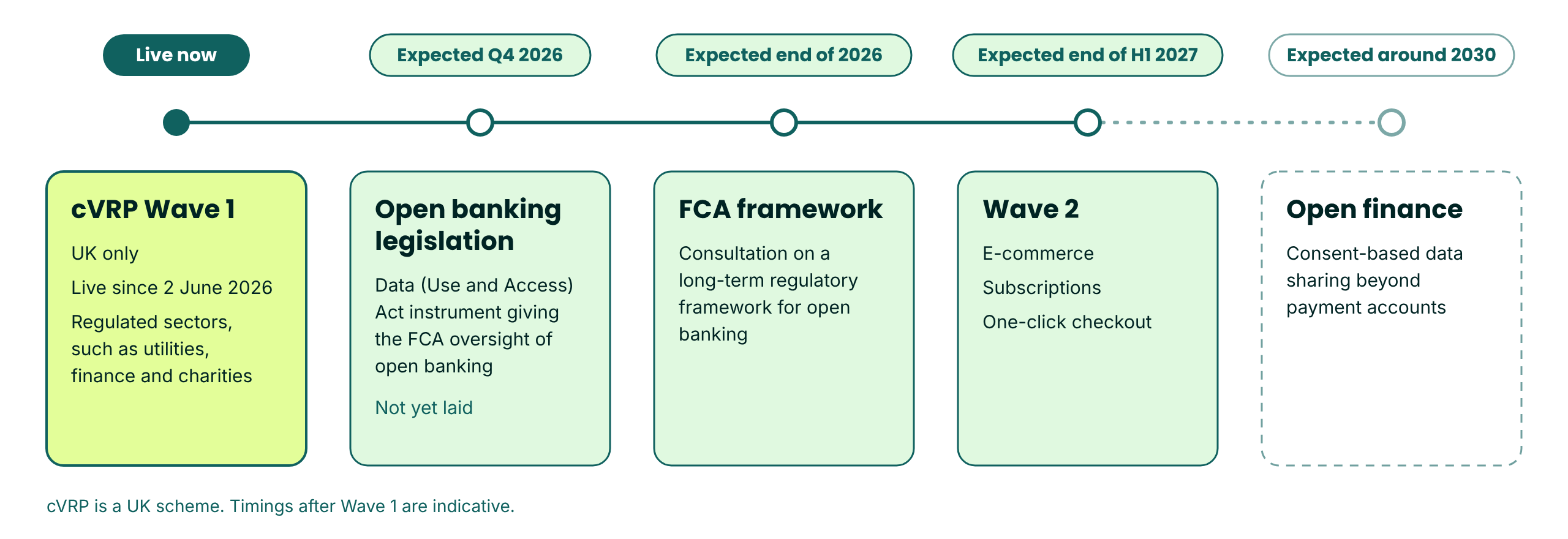
Yes. UKPI launched the commercial VRP scheme on 2 June 2026, and Wave 1 is live.
The FCA welcomed the launch, saying it wants to see competition between commercial open banking schemes. It is also supporting work to set up an independent body to set open banking standards. Subject to new legislative powers, the FCA plans to consult on a long-term regulatory framework for open banking by the end of 2026.
What is UKPI?
UK Payments Initiative Ltd (UKPI) is the industry-owned company that runs the cVRP scheme. It was founded by 31 organisations, including major UK banks, building societies, and fintechs, and it provides a shared rulebook, commercial model, and operational standards for the scheme. Yapily is one of those founding members and has helped shape how cVRP has been brought to market. Participation is not limited to the founders: Moneyhub joined in June 2026 as the first participant from outside the shareholder group.
cVRP Wave 1: which businesses can use it?
Wave 1 covers payments to five groups of regulated, lower-risk payees:
energy, utilities, and telecoms providers, plus rail
regulated financial services, such as pensions, investments, mortgages, and insurance
e-money institutions
central and local government
registered charities
These sectors were chosen because they are regulated, trusted, and low risk, which made them a sensible place to start a new scheme. Businesses outside them can't use commercial VRP under the current scheme rules.
Being in a Wave 1 sector makes a payment eligible for cVRP, but it also needs the payer's bank and the payment provider to support that sector. Banks and providers are switching on support one sector at a time, so if you are planning a cVRP launch, check which sectors your banks and infrastructure partner already cover.
For a sector-by-sector look at the opportunity, read our guide to Wave 1 cVRP.
cVRP Wave 2: when will e-commerce follow?
Wave 2 will bring e-commerce, subscriptions, and wider retail payments into scope, but no go-live date has been confirmed. Current expectations point to end of H1 2027.
Two things need to happen first. A statutory instrument under the Data (Use and Access) Act 2025, which will put open banking oversight on a new footing, is expected to be laid in the fourth quarter of 2026. The scheme also needs an agreed approach to purchase protection for online shopping.
Our view at Yapily is that Wave 2 is now targeted for the end of the first half of 2027, tracking that legislative timetable. James Tiltman, our VP of Payments, sets out why online checkout is cVRP's strongest use case, and what needs to happen to move Wave 2 forward, in cVRP Wave 2: e-commerce and agentic payments.
Wave 1 of cVRP is live, and the milestones that follow it are still estimates.
Consumer protection for cVRP payments
cVRP payments are covered by the legal protections that already apply to open banking payments, but there is not yet an agreed purchase-protection model for e-commerce comparable to card chargebacks. That gap matters most for Wave 2.
In January 2026, UK Finance, supported by Deloitte, proposed two options:
a debit-card-efficient model, where customers could claim purchase protection through their bank in a similar way to debit cards
a SIP+ model, which keeps today's open banking protections and adds cover if a merchant fails
UKPI has not yet said which approach it will take.
Why cVRP matters beyond recurring bills
A cVRP mandate is a set of rules the customer agrees once and their bank enforces on every payment that follows. That property is useful well beyond regular bills, which is why we see cVRP as more significant than a straight alternative to Direct Debit.
The clearest example is the returning customer. Paying a business by bank today usually means approving every payment, even with a merchant you have paid many times before. With a mandate in place, a customer can pay again without going through that step, so we expect one-click checkout to become cVRP's strongest use case once Wave 2 opens. A returning customer could pay a merchant they already use in one step, without going back to their banking app and without the merchant storing card details. That matters for e-commerce because saved cards are what make repeat online purchases quick today, and they are a large part of why cards remain the default way to pay online. One-click checkout through cVRP would let paying by bank offer the same convenience, with the customer's limits enforced by their bank on every purchase.
Giving AI agents permission to pay
Payments that run automatically within rules agreed in advance are also what AI agents will need if they are going to pay on someone's behalf: a clear permission, with limits the bank enforces. Our guide to how payments that follow rules agreed in advance work explains why cVRP is the UK's foundation for them.
James Tiltman, VP of Payments at Yapily, says: "With a cVRP mandate, the customer sets the limits once and their bank enforces them on every payment that follows. Wave 1 shows the scheme works for regular bills, but the bigger opportunity is the returning customer: someone paying a merchant they already trust again, without starting from scratch each time. That is the foundation programmable payments, and eventually AI agents, will be built on."
Why choose Yapily for cVRP?
Yapily is open banking infrastructure for businesses that build payments and financial data into their own products. Our APIs connect directly to banks, giving PSPs, lenders, and fintechs a single integration for both payments and account data. For cVRP, that means you can launch Wave 1 use cases on mandate infrastructure already proven with sweeping VRP, and build towards e-commerce and agent-initiated payments as the scheme widens. If you are weighing up cVRP for your product, these are the things about Yapily most likely to matter to you.
Data and payments through a single integration
Yapily gives you access to both account data and payments through one API. With one provider for both, you build and maintain a single integration, manage one partner relationship, and can design customer journeys that draw on data and payments together.
Consumer and business bank connectivity
We connect to both consumer and business bank accounts. You can serve individuals and businesses on one infrastructure, with no second provider as you grow. See our bank coverage.
A founding member of UKPI with a proven VRP track record
Yapily is one of the 31 founding organisations behind UKPI, so you work with a provider that has been part of the scheme from the start and is following how its rules develop towards Wave 2. cVRP also builds on the same mandate model as sweeping VRP, which we already run at scale. Across our sweeping VRP deployments, the payment success rate is 97%, and account top-up use cases see up to 90% of customers complete mandate setup. These are sweeping VRP results, and they show how the mandate rails underneath cVRP perform in practice.
cVRP available now for Wave 1 use cases
Yapily offers cVRP as a product for Wave 1 use cases today. If you serve customers in energy, utilities, telecoms, financial services, e-money, government, or charities, you can start building with it now. You can explore commercial VRP with Yapily to see how it works.
Building payments for AI agents
We are building the foundations for payments that AI agents can make on a customer's behalf: programmable payments built on cVRP, and financial insights built on open banking data. Our article on programmable payments and financial insights sets out where we are taking this.
Talk to an expert about cVRP
Whether you are in a Wave 1 sector today or planning for e-commerce, our open banking experts can help you work out whether cVRP fits your use case and what it would take to get started. Talk to an expert.
FAQs about cVRP
What is cVRP?
cVRP, or commercial variable recurring payments, is a UK open banking payment method that lets a customer give a business permission to take payments of varying amounts from their bank account, within limits the customer sets once. The customer's bank checks each payment against those limits. cVRP has been live since June 2026 for Wave 1 sectors, under a scheme run by the UK Payments Initiative (UKPI).
What is the difference between sweeping VRP and commercial VRP?
Sweeping VRP moves money between accounts that belong to the same person, such as from a current account into savings, and the largest UK banks have been required to offer it since 2022. Commercial VRP pays someone else: a business, a government body, or a charity. It runs under a commercial scheme operated by UKPI and went live for Wave 1 sectors in June 2026.
Is cVRP available outside the UK?
No. cVRP is a UK payment scheme, operated by the UK Payments Initiative and built on UK open banking. It is only available in the UK, and for now only for payments to businesses and organisations in the Wave 1 sectors: energy, utilities, telecoms and rail; regulated financial services; e-money institutions; government; and registered charities.
Can my business use commercial VRP if it isn't in a Wave 1 sector?
Not yet. Under the current scheme rules, commercial VRP can only be used to pay businesses and organisations in Wave 1 sectors: energy, utilities, telecoms and rail; regulated financial services; e-money institutions; government; and registered charities. Wave 2 is expected to extend cVRP to e-commerce, subscriptions, and wider retail, but no date has been confirmed.
When will cVRP Wave 2 launch?
No launch date has been confirmed. Wave 2, which would bring e-commerce and subscriptions into scope, is currently expected in 2027. It depends on a statutory instrument under the Data (Use and Access) Act 2025, expected to be laid in the fourth quarter of 2026, and on the industry agreeing a purchase-protection model for online payments.
What is UKPI?
UK Payments Initiative Ltd (UKPI) is the industry-owned company that operates the commercial VRP scheme in the UK. It was founded by 31 organisations, including major banks, building societies, and payment firms, and it provides the scheme's rulebook, commercial model, and operational standards. UKPI launched the scheme on 2 June 2026, starting with Wave 1 sectors.
Sources
Financial Conduct Authority, Open banking takes next step forward with launch of UK Payments Initiative scheme, 2 June 2026
Financial Conduct Authority, Open banking: a year of progress, December 2025
Open Banking Limited, An industry first: the UK's new commercial open banking scheme (VRP share of payments, October 2025)
Open Banking Limited, UK open banking hits one billion payments milestone, via Finextra, July 2026
Pay.UK, Market perceptions of Direct Debit, 28 July 2026
Payment Expert, Why UK consumers still rely on Direct Debit, 30 July 2026
UK Finance, UK Payment Markets 2026: summary, August 2026
Open Banking Expo, UK Finance proposes commercial model for Wave 2 cVRP, 9 January 2026
A&O Shearman, Payment services and payment systems in 2026
Norton Rose Fulbright, Regulation Tomorrow, UK Payments Initiative: UK banks and fintechs launch new payment scheme, 5 June 2026
Modulr, Commercial VRP Wave 1: a guide for eligible businesses, June 2026
The Paypers, Moneyhub joins UKPI as a non-shareholder participant, 23 June 2026